


A brighter smile sounds simple enough: whiten your teeth, lift the stains, and enjoy a fresher, more polished look. But many patients are surprised to find that after whitening, one tooth still looks darker, an older filling stands out more clearly, or a front crown no longer blends in the way it used to.
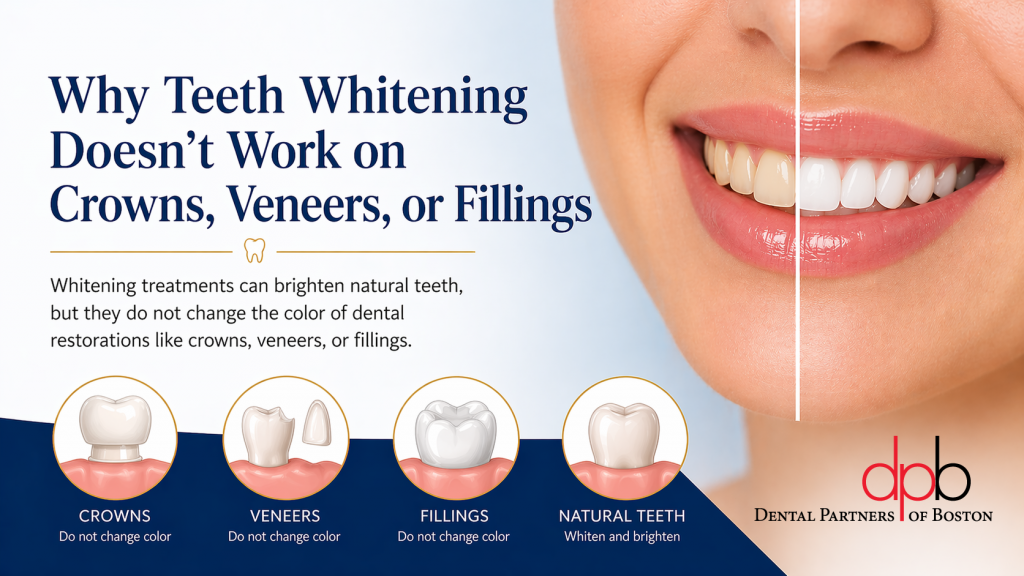
That disconnect is common, and it usually comes down to one important detail: whitening treatments work on natural tooth structure, but they do not change the color of dental restorations like crowns, veneers, or tooth-colored fillings. Professional teeth whitening can dramatically improve the shade of natural teeth through in-office treatment or custom take-home trays, while other cosmetic options may be better suited for certain types of discoloration.
If you have visible dental work and are thinking about whitening, it helps to understand what can change, what cannot, and how to plan for a smile that looks brighter and more even overall.
How professional teeth whitening works
Professional whitening is designed to reduce stains within natural enamel. At Dental Partners of Boston, patients can choose between in-office Philips ZOOM! whitening and custom take-home whitening trays, depending on their goals, lifestyle, and timeline. The practice notes that in-office whitening can produce noticeably whiter teeth in a single appointment, while take-home whitening offers a more gradual approach with custom trays for even coverage and touch-ups over time.
That distinction matters because whitening is not paint, polish, or a surface coating. It is a process that targets discoloration in natural teeth. If most of your visible smile is made up of natural enamel, whitening can be an excellent way to brighten your appearance. If part of your smile includes restorations, though, those materials will usually stay the same shade they were when they were placed.
This is one reason a professional evaluation matters before treatment. DPB emphasizes supervised care and personalized treatment planning, which can help identify older dental work before whitening begins and reduce the risk of unexpected shade mismatch afterward.
Why crowns, veneers, and fillings do not whiten
Natural teeth and dental restorations do not respond to whitening in the same way because they are made of different materials.
A natural tooth has enamel and underlying dentin, both of which can contribute to the overall shade of the tooth. Whitening agents are formulated to lighten stains within natural teeth. A crown, veneer, or filling, on the other hand, is made from a restorative material selected to match your smile at the time it is placed. That shade is intended to stay stable rather than lighten along with surrounding teeth.
Dental veneers are designed to improve the look of teeth that are chipped, worn, uneven, or discolored. Cosmetic bonding uses tooth-colored material to improve shape and appearance. All-porcelain dental crowns are used to restore teeth that are damaged or weakened while also improving how they look. In all three cases, the goal is long-term esthetics and function, not future responsiveness to whitening gel.
That means if you whiten your natural teeth, your existing restorations may stay exactly where they are in shade. The result is not that whitening “failed.” It is that part of your smile changed, and part of it did not.
Why one tooth may look darker after whitening
Patients often assume whitening should affect every visible tooth evenly. In real life, that is not always what happens.
One common scenario involves a single front tooth that has a crown from a past injury or a prior root canal. Before whitening, that crown may blend reasonably well with the surrounding teeth. After whitening, the natural teeth brighten while the crown stays the same. Suddenly, the difference is much more noticeable.
The same thing can happen with:
- older tooth-colored fillings near the edges of front teeth
- bonding used to repair chips or reshape enamel
- veneers placed years ago in a slightly warmer shade
- one tooth with internal discoloration that does not respond like neighboring teeth
Even patients who are good candidates for whitening can run into this issue if they have visible restorations in the smile zone. That does not mean whitening should be avoided. It means treatment should be planned with the full smile in mind.
Can you still whiten your teeth if you have dental work?
In many cases, yes. Whitening can still be worthwhile if most of the teeth that show when you smile are natural. It can also make sense if you are planning to replace an older restoration after whitening so the new one can be matched to your brighter shade.
This sequence is often the smartest approach: whiten first, let the new shade settle, then update visible restorations if needed. That gives your dentist a more accurate target when matching a veneer, bonding repair, or crown to the rest of your smile.
For some patients, the restoration is toward the back of the mouth or not visible in normal conversation. In that case, whitening your natural teeth may still give you the improvement you want without any need to change existing dental work.
For others, especially if a front tooth restoration is already prominent, a cosmetic plan may be more important than whitening alone. Dental Partners of Boston offers several cosmetic dentistry services, including veneers, cosmetic bonding, and porcelain crowns, which makes that kind of planning especially valuable when color, symmetry, and smile balance all matter.
What to do if your restorations no longer match
If whitening leaves part of your smile looking uneven, the next step is not usually more whitening. It is choosing the right cosmetic solution for the tooth or teeth that no longer blend in.
Small discrepancies may be addressed with cosmetic bonding, especially if the issue involves a minor chip, shape irregularity, or localized mismatch. Bonding can be a conservative option when only a small amount of correction is needed.
Veneers may be a better fit when the concern is more visible on the front teeth or when color is only one part of the problem. Veneers can also improve contour, proportion, and surface appearance, making them especially useful when a patient wants a more comprehensive upgrade rather than a single repair.
Crowns are often appropriate when a tooth needs both cosmetic improvement and structural reinforcement. If a tooth is cracked, heavily restored, or weakened, a crown can restore its strength while improving shade and appearance at the same time.
The right answer depends on what the tooth needs, where it sits in the smile, and whether the concern is purely cosmetic or also functional.
When whitening may not be the best first step
Sometimes the real problem is not surface staining at all. A tooth may look dark because of internal discoloration, old trauma, previous dental treatment, or the presence of restoration material that has aged differently than the surrounding teeth. In those situations, whitening may help nearby natural teeth but still leave the main concern untouched.
This is why patients with older cosmetic work should be careful about expecting a one-size-fits-all solution. Professional whitening is excellent for many smiles, but it is not a universal fix for every kind of discoloration. In fact, DPB’s whitening page specifically notes that some cases are better addressed with alternatives such as bonding or crowns.
A thoughtful cosmetic exam can help answer a few important questions before treatment starts:
- Are the teeth that bother you natural teeth or restored teeth?
- Is the discoloration external, internal, or related to older dental work?
- Will whitening improve the smile evenly, or expose mismatched dental work?
- Would a restoration update create a better result than whitening alone?
Those are the questions that turn a routine whitening appointment into a more strategic smile plan.
Why a professional exam matters before whitening
One of our older posts on at-home vs. in-office whitening explains why dentist-supervised whitening is safer and more effective than relying on DIY options alone. It highlights stronger whitening agents, custom trays, gum protection, and the value of making sure there are no underlying oral health issues before treatment begins.
That same professional oversight is also what helps patients avoid disappointment when restorations are involved.
A dentist can identify crowns, veneers, bonding, and fillings that may not respond to whitening. They can also help you understand whether whitening should happen before cosmetic updates, or if a single tooth needs a different solution, or whether a broader smile makeover approach makes more sense.
For patients in Boston who want results that look polished rather than pieced together, that planning step is often the difference between a brighter smile and a truly balanced one.
A brighter smile should still look natural
The goal of whitening is not simply to make teeth lighter. It is to make your smile look healthier, fresher, and more harmonious. If you already have crowns, veneers, or fillings, the best cosmetic result may involve more than whitening alone.
Professional whitening can absolutely be part of the plan. But if certain teeth do not respond because they are restored rather than natural, the next step may be updating those visible restorations so everything works together.
If you are considering whitening and already have dental work, a cosmetic consultation can help you avoid surprises and choose the right path from the start. At Dental Partners of Boston, that may mean whitening, bonding, veneers, crowns, or a combination that gives you a brighter smile without leaving one tooth behind.
Schedule a cosmetic consultation with Dental Partners of Boston to find out if professional whitening alone is the right choice for your smile, or whether updating older restorations would create a more even result.